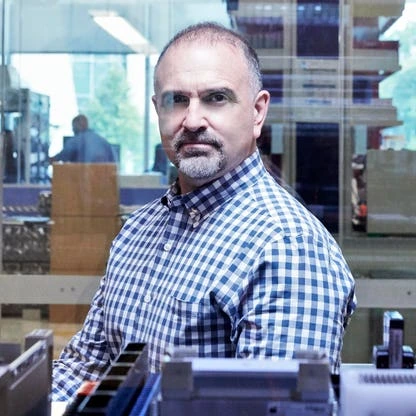
Yancopoulos is of Greek descent, and his trajectory from scientist to billionaire-adjacent executive makes him a natural subject for anyone researching the wealth of prominent Greeks in business and science. Unlike shipping magnates or real estate developers whose wealth is often more visible, his fortune is almost entirely tied to a publicly traded company, which means the numbers can be tracked with reasonable precision, but also shift with every quarterly earnings report and stock-price move. If you are trying to understand where he stands financially as of April 2026, the answer is grounded almost entirely in Regeneron's share price and his disclosed ownership stake.
The best net-worth estimate right now (and why it is a range, not a number)

As of early April 2026, the most credible publicly available estimates place George Yancopoulos's net worth somewhere between roughly $480 million and $875 million. Quiver Quant, which pulls directly from SEC insider ownership data, estimated at least $480.3 million as of March 11, 2026. GuruFocus, using the same SEC source material but applying a slightly different share-count methodology, put the figure at at least $875 million as of April 2, 2026. Forbes has noted that he owns approximately 1% of Regeneron stock, with their profile last updated March 10, 2026.
The gap between $480 million and $875 million is not a sign that one source is wrong and the other is right. It reflects genuine methodological differences: which share classes are counted, whether vested options and RSUs are included, what share price is used as the reference point, and whether real estate or other non-equity assets are folded in. All of these are legitimate choices, and any honest estimate of insider wealth comes with those caveats baked in. Think of it as a range, not a hard figure.
Where the money actually comes from: a source breakdown
Regeneron equity: the dominant asset
The overwhelming majority of Yancopoulos's wealth sits in Regeneron (ticker: REGN) shares. SEC Form 4 filings under his name, listed as "Bd. Co-Chair, President & CSO" for Regeneron Pharmaceuticals, confirm his ongoing beneficial ownership. Forbes's shorthand of roughly 1% ownership is a useful anchor: Regeneron's market cap as of early 2026 is in the range of $50 to $80 billion depending on the date you check, so 1% translates to somewhere in the $500 million to $800 million ballpark, which aligns with the tracker estimates above.
Options and RSUs

Regeneron's 2024 proxy statement (DEF 14A, filed with the SEC) breaks down beneficial ownership into several components: direct shares, options exercisable within 60 days of the April 16, 2024 reference date, and RSUs releasable within the same window. These equity instruments inflate the "beneficial ownership" figure reported in the proxy versus the raw share count you would find in a Form 4. That distinction matters when you are trying to reconcile numbers across different databases, because some trackers include vested options in the total and others do not.
Dividend income
Regeneron initiated its first-ever quarterly cash dividend program in February 2025, declaring $0.88 per share on both its Common Stock and Class A Stock. Regeneron’s 2024 Annual Report materials state that in February 2025 the board declared its first quarterly cash dividend of $0.88 per share $0.�5 per share. Subsequent quarters continued the same rate, with an April 2025 declaration of $0.88 per share payable June 6, 2025. For a holder of roughly 1% of Regeneron's shares, that translates to a meaningful recurring income stream, though it is a supplement to equity value rather than the core wealth driver.
Executive compensation
The proxy statement also references Yancopoulos's cash compensation, including base salary and annual cash incentives determined by the Compensation Committee based on company performance. The 2024 proxy notes that the committee focused on overall company performance metrics for 2023 cash incentive decisions. There are also miscellaneous line items, such as company-paid fees related to Hart-Scott-Rodino Act filings. These cash compensation components are real but relatively minor compared to the equity stake.
Real estate

One documented non-equity asset is a Manhattan property: deal records show a purchase of 44 Hudson Street in Tribeca for $9.6 million, made through an entity called 44 Hudson Holdings LLC and attributed to George Yancopoulos. Real estate at that price point is a rounding error relative to his equity holdings, but it is worth noting as a confirmed tangible asset. His SEC filings list a Tarrytown, NY address, consistent with Regeneron's headquarters location in Westchester County.
How to verify or update these numbers yourself
If you want to do your own calculation, here is a practical workflow that takes maybe 20 minutes and gives you a more current figure than most aggregator sites.
- Go to the SEC's EDGAR system (sec.gov/cgi-bin/browse-edgar) and search for "Yancopoulos" as a filer. Look for the most recent Form 4 filed under REGN to get his latest reported share count.
- Find the most recent DEF 14A for Regeneron on EDGAR (search under Regeneron's CIK). The beneficial ownership table will give you a more complete picture including options and RSUs vesting within 60 days.
- Pull the current REGN share price from any financial data source. Multiply that price by the share count from the Form 4 or proxy to get a base equity value.
- Add in options value if you want a fuller picture: take the number of exercisable options, subtract the exercise price from the current share price, and multiply by share count. Ignore underwater options.
- Cross-check your figure against GuruFocus or Quiver Quant, which automate this process. If your number differs significantly, the most likely culprit is a stale share price or a difference in whether options are included.
One important timing note: the proxy statement's beneficial ownership table uses a fixed reference date (April 16, 2024 for the 2024 proxy). That means options and RSU counts reflect what was vested or exercisable as of that date, not today. For a current estimate, the most recent Form 4 transaction data is more reliable than the proxy ownership table.
Common misconceptions and how to avoid bad data

The most recycled bad data point floating around is the Forbes 2018 estimate of approximately $900 million. That figure was accurate at a specific moment in 2018 when Regeneron's stock was trading at a particular price. Since then, REGN has had significant swings in both directions, and using that number without checking today's share price is a classic example of stale syndication. Dozens of sites copy old estimates without updating them, so any source that cites $900 million without a recent date attached should be treated with caution.
Another common error is identity confusion. There are other individuals named George Yancopoulos in public records, and some financial data aggregators have misattributed transactions or filings. The reliable identity anchors are: full name George D. Yancopoulos, MD, PhD; role as Bd. Co-Chair, President & CSO of Regeneron Pharmaceuticals; Tarrytown, NY address; and the issuer ticker REGN on all SEC filings. If a source does not clearly match all of these identifiers, treat it skeptically.
A third trap is double-counting. Some net-worth estimates add the full beneficial ownership figure from the proxy (which includes options) to a separate count of direct shares, effectively counting the same equity twice. Always check the footnotes of any beneficial ownership table to understand what is and is not included in the headline number.
Comparing estimates across sources
| Source | Estimate | Reference Date | Methodology Note |
|---|
| Quiver Quant | At least $480.3M | March 11, 2026 | SEC insider holdings, current REGN price |
| GuruFocus | At least $875M | April 2, 2026 | SEC insider ownership, broader equity inclusion |
| Forbes | ~$900M (2018 benchmark) | July 2018 (recycled) | Stock-centric, now outdated without update |
| Forbes profile | ~1% of REGN | March 10, 2026 | Ownership fraction, not a dollar figure |
| This article's estimate | $500M–$875M range | April 2026 | Aggregated from SEC filings and current REGN price |
If you are trying to pick a single number for reference purposes, the GuruFocus figure of at least $875 million (as of early April 2026) is the most recent dollar estimate and uses the broadest share-count methodology. But treat the full range of $480 million to $875 million as the honest picture, with the variance explained by the methodological choices outlined above.
How his career path built this wealth
Yancopoulos co-founded Regeneron in 1989 after a career in academic science. The key wealth-building mechanism was founding equity: he received shares at or near the company's inception, long before Regeneron became a commercial success. Most of the value creation happened slowly over the company's first two decades as it developed its drug pipeline, and then accelerated dramatically when blockbuster drugs like Eylea and Dupixent drove the stock from under $20 in the early 2000s to well over $700 at various points in the 2020s.
This pattern, where a scientist or founder holds equity from near-inception and benefits from compounding value over 30-plus years, is meaningfully different from wealth built through acquisitions, real estate, or financial engineering. It also means his net worth is directly tethered to Regeneron's pipeline performance and stock price, not a diversified portfolio. A bad clinical trial result or a regulatory setback can move his net worth by hundreds of millions in a single day.
That kind of wealth concentration is actually common among founder-scientists at major biotech companies, and it creates a specific research challenge: you cannot look at one static number and call it settled. This is somewhat different from, say, researching the net worth of a shipping magnate whose assets are more stable, or compared to someone like George Argyros, whose wealth is grounded in real estate and diversified holdings that do not fluctuate with a single stock ticker.
The biotech founder model also explains why Yancopoulos's wealth looks different from that of, say, George Embiricos, a name associated with the Greek shipping world where capital is tied to vessels and freight contracts. Yancopoulos built wealth through scientific output and intellectual property, and the equity he holds today is the financial reward for that 35-year bet on Regeneron's science.
Latest updates and what to check next
As of April 2026, there are no publicly reported major share sales, dramatic equity restructuring, or significant non-equity asset disclosures that would shift the estimate materially beyond the $480 million to $875 million range. Regeneron's dividend program, initiated in early 2025 at $0.88 per share per quarter, has continued as of the most recent declarations, adding a modest but consistent cash return for holders like Yancopoulos.
The most important single variable to monitor going forward is REGN's stock price. Regeneron's shares have been sensitive to pipeline news, particularly around its Dupixent franchise and any late-stage trial readouts. A 20% move in REGN shares could shift Yancopoulos's estimated net worth by $100 million or more, which is why any estimate you read has a shelf life of weeks, not years.
For ongoing research, bookmark Regeneron's EDGAR page and set up a Form 4 alert for "Yancopoulos" as a filer. That will notify you whenever he buys, sells, or receives new equity grants, giving you the most current ownership picture without waiting for quarterly trackers to update. The next proxy statement (typically filed in April or May each year) will also refresh the full beneficial ownership table with a new reference date.
If you are exploring this topic in the broader context of Greek business wealth, it is worth noting how different Yancopoulos's profile is from peers like George Frangoulis or figures in the George Notaras net worth space, where business models and asset structures are fundamentally different. Biotech equity wealth is volatile but traceable; the SEC filings give you more transparency than most other industries. That is actually an advantage when doing this kind of research: you are not guessing at private valuations or shipping fleet appraisals. The core data is publicly filed, free to access, and updated frequently.
For those curious about other prominent Greeks who built wealth through professional and entrepreneurial paths rather than traditional industries, it is also useful to compare trajectories. The wealth profile of someone like George Gerasimou or the documented holdings associated with George Chatzigeorgiou illustrate just how varied the sources of Greek wealth can be. Similarly, the contrast with Eastern European-connected business figures like George Copos, or even a politician-turned-executive like George Saitoti, shows that researching any single individual's wealth requires understanding the industry context first, then following the paper trail.
The bottom line for anyone researching George Yancopoulos's net worth today: use the GuruFocus or Quiver Quant figures as your starting baseline, verify the share count against the most recent Form 4 on EDGAR, apply the current REGN share price, and treat the result as a range rather than a precise number. That approach will get you closer to the truth than any single recycled estimate you find on a content-farm net-worth site.