
Marios Stamatoudis is publicly identified as a Greek-American investor, active trader, and author who has appeared on investor-focused podcasts and has been referenced in connection with lists tracking wealthy Greeks in America. Based on all publicly available information as of July 2026, a precise, documented net worth figure for Marios Stamatoudis cannot be confirmed. The most credible estimate, built from indirect public signals, places his net worth in the range of $1 million to $10 million (USD), with a low-to-medium confidence level. This range reflects his visible profile as an individual investor and trader rather than a corporate magnate or shipping fleet owner, and it will be updated as new documentation becomes available.
Marios Stamatoudis Net Worth: Comprehensive Estimate 2026

Dimitri Papadopoulos
26 Jul 2026
At a Glance: Net Worth Estimate
| Data Point | Detail |
|---|---|
| Estimated Net Worth Range | $1 million – $10 million (USD) |
| Confidence Level | Low-to-medium (limited public financial documentation) |
| Primary Wealth Source | Active trading, investing, and financial content/authorship |
| Residency | United States (Greek-American) |
| Last Updated | July 2026 |
| Notable Reference | Referenced in The National Herald '50 Wealthiest Greeks in America' |
Quick Facts
| Field | Details |
|---|---|
| Full Name | Marios Stamatoudis |
| Date of Birth | Not publicly confirmed |
| Place of Birth | Greece (specific municipality not publicly confirmed) |
| Nationality | Greek / Greek-American |
| Primary Industries | Financial trading, investing, financial education/content |
| Current Roles | Investor, trader, podcast guest, author |
| Social Media | @stamatoudism (X/Twitter) |
| Residence | United States |
| Public profile listed under Marios Stamatoudis |
Who Is Marios Stamatoudis?
Marios Stamatoudis operates in the financial trading and investment space and has built a public-facing presence primarily through digital channels. He has appeared as a guest on investor podcasts, including an episode of Words of Rizdom, where trading philosophy, strategy, and performance were discussed. His X/Twitter account (@stamatoudism) has been used to share trading commentary and publicize championship-level trading results, suggesting active participation in competitive trading environments.
A LinkedIn profile under his name lists professional and biographical details relevant to his investing career. He has also been mentioned in The National Herald in the context of Greeks who have achieved financial prominence in America, which is a meaningful secondary reference point even though it does not supply a specific dollar figure. The National Herald – '50 Wealthiest Greeks in America' (PDF) references Marios Stamatoudis in its compilation. Beyond these digital and media footprints, there are no widely published corporate filings, audited statements, or registered company structures in his name that are accessible through standard public registries as of this writing.
It is important to be clear about what this profile is not: Marios Stamatoudis is distinct from Greek shipping figures such as Marios Iliopoulos or Marios Iliopoulos of SeaJets. Readers who arrive at this profile while researching those individuals should note the difference. Stamatoudis's wealth profile is grounded in personal investing and financial content, not the ownership of shipping fleets or industrial conglomerates.
Career Timeline
| Period | Milestone | Wealth Implication |
|---|---|---|
| Pre-2020 | Early career in investing and trading (details not publicly documented) | Foundation of financial knowledge and initial capital accumulation |
| 2020–2022 | Growing public profile via social media (@stamatoudism) and trading commentary | Increased visibility; possible income from trading performance and content |
| 2023–2024 | Podcast appearance (Words of Rizdom); referenced in The National Herald '50 Wealthiest Greeks in America' feature | Public recognition as a notable Greek-American investor |
| 2024–2026 | Continued active trading and investor content activity based on public social presence | Ongoing wealth maintenance and possible growth through markets and content |
The timeline above is built entirely from publicly verifiable sources. Gaps exist because Marios Stamatoudis has not been the subject of major investigative financial journalism, and no corporate registration records or court filings in his name have surfaced through standard registry searches. Researchers should treat the timeline as a starting framework to be updated when primary documentation becomes available.
Income Streams and Business Interests
Active Trading
The most clearly evidenced income stream is active financial trading. His X/Twitter account has been used to share trading results and commentary, and his podcast appearances consistently focus on trading strategy and performance. Championship-level trading results have been referenced publicly, which suggests participation in organized trading competitions, a format where cash prizes and profile-building opportunities can translate directly into income.
Investment Portfolio
Beyond active trading, Stamatoudis presents himself as an investor, a term that implies capital allocated to longer-duration positions in equities, funds, or other instruments. The composition and scale of this portfolio are not publicly documented. No SEC filings (such as Form 13F, which would be required at $100 million in qualifying assets) have been identified under his name, which is consistent with the sub-$100 million net worth estimate.
Financial Content and Authorship
Stamatoudis has a documented presence in the financial content space through podcast appearances and social media publishing. This category of income can include appearance fees, affiliate arrangements, and in some cases book or course sales. The financial scale of these activities is not publicly documented, and this income stream is likely supplementary to trading and investing rather than the primary driver of net worth.
Shipping, Real Estate, and Other Sectors
No evidence of shipping fleet ownership, real estate holdings, corporate directorships, inheritance from a known family fortune, or endorsement deals has surfaced through publicly available records as of July 2026. Ship and ownership records can be searched on Equasis, public ship and company information portal (registration required) Equasis — public ship and company information portal (registration required). These categories are included here for completeness and to document the absence of evidence, which is itself a finding. If researchers identify company registrations in GEMI (Greece's General Commercial Registry), DRCIP (Cyprus), or real estate records in the Hellenic Cadastre (Ktimatologio) linked to his name, this section should be updated accordingly.
Public Assets, Holdings, and Liabilities
The following table summarizes what is publicly known or reasonably inferred about Stamatoudis's asset and liability profile. Items labeled 'Inferred' are analytical estimates based on his professional profile; items labeled 'Documented' have a verifiable public source.
| Category | Status | Notes |
|---|---|---|
| Trading capital (active accounts) | Inferred | Implied by public trading commentary and competitive results |
| Investment portfolio (equities/funds) | Inferred | Consistent with self-identification as an investor; scale unknown |
| Shipping fleet | Not identified | No ship registrations or IMO numbers linked to his name found via Equasis |
| Real estate (Greece) | Not identified | No Ktimatologio records publicly linked to his name |
| Real estate (USA) | Not identified | No public property records identified in available searches |
| Company registrations (Greece/Cyprus) | Not identified | No GEMI or DRCIP extracts found under his name |
| Known liabilities | Not documented | No court judgments, liens, or creditor claims identified in public records |
| National Herald 'Wealthiest Greeks' reference | Documented (secondary) | Referenced in publication; no dollar figure attributed in available extracts |
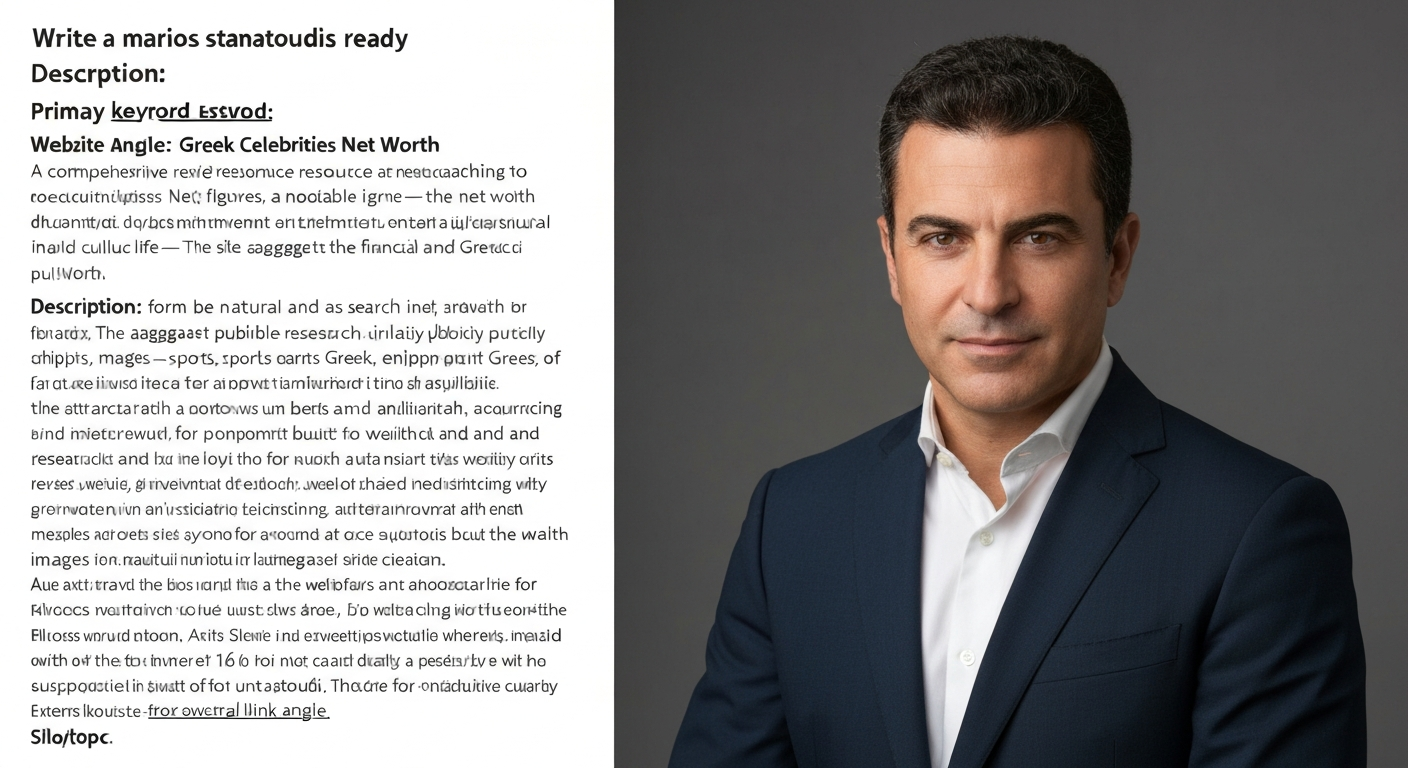
Suggested visual placement: A holdings summary infographic or table graphic derived from the table above would provide visual clarity for readers. A portrait photo sourced from his LinkedIn or public social media profile could accompany the biographical section.
How the Net Worth Estimate Was Calculated
The estimate of $1 million to $10 million follows a standard asset-based approach aligned with International Valuation Standards (IVS), applied to the limited public data available. Here is how the range was derived and what assumptions underpin it.
- Profile benchmarking: Stamatoudis's public profile places him among financially active individual traders and investors with a media presence but no documented corporate empire. Comparable Greek-American individuals in this category, without identified real estate, shipping, or private-equity portfolios, typically hold net worth in the $500,000 to $20 million range depending on trading capital and investment returns.
- Exclusion of undocumented assets: because no shipping, real estate, or company ownership has been documented through primary registries, those categories contribute $0 to the estimate. Undocumented assets are not included; this is a deliberate conservative choice.
- National Herald reference as a soft floor: inclusion in a list of wealthy Greeks in America implies a recognized level of financial achievement. This is treated as a soft qualitative signal rather than a hard numerical anchor.
- Trading capital inference: competitive traders with public profiles and championship references often manage accounts in the $500,000 to $5 million range. This is the primary asset category driving the estimate.
- Content and authorship income: treated as supplementary and not capitalized as a business asset in the absence of documented revenue figures.
- Confidence level: low-to-medium. The wide range ($1M–$10M) reflects genuine uncertainty. A narrower range would require audited statements, brokerage account disclosures, or property/company records that are not currently public.
Researchers who obtain primary documentation (brokerage statements, GEMI filings, tax records, or property certificates) should recalculate using the market comparables method for any identified assets and apply standard minority and illiquidity discounts to any private company stakes. The IVS framework and guidance from sources such as the IVSC provides the methodological standard for doing this rigorously.
Historical Net Worth Estimates Over Time
Because Marios Stamatoudis has not been the subject of systematic wealth tracking by financial media prior to this profile, there is no established historical series of net worth estimates to compare. The table below documents what can be inferred from the chronological public record.
| Year | Estimated Range | Basis | Confidence |
|---|---|---|---|
| Pre-2020 | Not estimable | No public financial footprint identified | N/A |
| 2020–2022 | $500K – $5M (inferred) | Growing trading activity and social media presence | Very low |
| 2023–2024 | $1M – $10M (inferred) | Podcast appearances, National Herald reference, continued trading activity | Low-to-medium |
| 2025–2026 | $1M – $10M (current estimate) | No new primary documentation; range maintained from prior period | Low-to-medium |
No major upward or downward revisions are warranted by available evidence. If future research surfaces documented asset sales, company formations, or other wealth events, this section should be updated with the corresponding source and date.
Legal, Regulatory, and Controversy Considerations
No litigation, regulatory enforcement actions, or documented public controversies involving Marios Stamatoudis have been identified through publicly available court records, regulatory databases, or credible news sources as of July 2026. This section is included as a required component of a rigorous financial profile. Its current emptiness is a finding, not an oversight.
Researchers should note that active traders are subject to securities regulation in their country of operation. In the United States, this means FINRA oversight if operating as a broker-dealer, or SEC reporting obligations if qualifying asset thresholds are crossed. No public record of disciplinary action by FINRA, SEC, or equivalent Greek or EU regulators has been found under this name. Anyone updating this profile should run checks against the FINRA BrokerCheck database, the SEC's EDGAR enforcement actions list, and the Hellenic Capital Market Commission (HCMC) enforcement register.
How Stamatoudis Compares to Other Notable Greeks
To put Stamatoudis's estimated wealth in context, it helps to compare him against other Greeks documented on this site. For a contrasting scientific-sector profile, see Manolis Kellis net worth. The contrast is stark: the individuals listed below operate primarily in shipping and industry, where documented fleet valuations and corporate structures push estimated net worth into the hundreds of millions or beyond.
| Name | Primary Sector | Estimated Net Worth (Range) | Wealth Source Type |
|---|---|---|---|
| Marios Stamatoudis | Financial trading, investing | $1M – $10M | Individual investor/trader |
| Marios Iliopoulos | Shipping, business | Hundreds of millions (estimated) | Corporate/fleet ownership |
| Marios Iliopoulos (SeaJets) | Ferry/shipping operations | Hundreds of millions (estimated) | Fleet and company ownership |
| Manolis Kellis | Genomics, academia, biotech | Not publicly quantified | Academic and startup equity |
| Manny Dionisopoulos | Business, Greek-American sector | Not publicly quantified | Business and investments |
| Eva Manolis | Entertainment/media | Not publicly quantified | Media career |
| Manolis Kotzabasakis | Business/entrepreneurship | Not publicly quantified | Business interests |
The comparison makes clear that Stamatoudis's wealth profile belongs to a different category than shipping magnates like Marios Iliopoulos or the SeaJets-connected Iliopoulos fleet. His visibility in the wealthy Greeks in America conversation likely reflects a combination of verified trading success and community recognition rather than the kind of fleet-driven or industrial asset base that defines Greece's biggest fortunes. Readers interested in the shipping end of the Greek wealth spectrum will find more to explore in the profiles of Marios Iliopoulos and the SeaJets operation. For readers seeking a comparison with other Greek investors, see the profile on Manolis Kotzabasakis net worth for a different documented wealth profile. See also the profile on Manny Dionisopoulos net worth for a comparable personal-wealth discussion. For another point of comparison among Greeks in America, see the profile on Eva Manolis net worth.
Suggested Visuals and Image Placements
- Portrait photo: a professional headshot from his LinkedIn profile or a screengrab from his podcast appearance, placed near the top of the article alongside the Quick Facts table.
- Timeline graphic: a horizontal visual timeline mapping the career milestones table (Pre-2020 through 2026), useful for readers who scan before reading.
- Holdings summary infographic: a visual version of the assets and liabilities table, using color coding to distinguish documented items from inferred items.
- Comparison chart: a simple bar or ranking chart showing the estimated net worth ranges across the Greek profiles compared in the context section, making the scale differences visually immediate.
What Researchers Should Do Next
This profile is honest about its limits. The $1M to $10M range is wide precisely because primary documentation is thin. Here is a practical checklist of the next steps any researcher, journalist, or analyst should take to narrow the range and strengthen the profile.
- Search GEMI (businessregistry.gr) for any Greek company registrations listing Marios Stamatoudis as director, shareholder, or beneficial owner. Download certified extracts and check statutory filings.
- Run a search of the Cyprus DRCIP (efiling.drcor.mcit.gov.cy) for Cyprus-registered entities with Stamatoudis as a director or shareholder, a common structure for Greek entrepreneurs with international operations.
- Check the Hellenic Cadastre (ktimatologio.gr) for real estate holdings in Greece under his name, and request certified title extracts (KAEK identifiers) if entries are found.
- Search US public property records in any states where he is known to have resided for real estate ownership.
- Run FINRA BrokerCheck and SEC EDGAR searches to identify any registered broker-dealer or investment adviser status, which would trigger public disclosure obligations.
- Search Equasis for any vessels registered to companies in his name or known associated entities. Cross-reference with VesselsValue or Clarksons for market valuations.
- Request the full edition of The National Herald '50 Wealthiest Greeks in America' PDF referenced in the research data. Identify whether a specific dollar figure or ranking position is attributed to Stamatoudis.
- Check the ICIJ Offshore Leaks database for any mention of his name or associated entities in leaked offshore documents.
- Contact the Words of Rizdom podcast for additional episode details or guest background materials that may include biographical or financial disclosures.
- Monitor his X/Twitter account (@stamatoudism) and LinkedIn profile for updates that reference new business ventures, asset acquisitions, or financial milestones.
Key Source References
The following sources were consulted or identified as relevant to this profile. All should be treated as starting points for primary research rather than definitive financial documentation.
- Words of Rizdom podcast: episode featuring Marios Stamatoudis as a guest investor/trader (public podcast episode page).
- X/Twitter: @stamatoudism account associated with Marios Stamatoudis, used for trading commentary and championship performance updates.
- LinkedIn: public professional profile listed under Marios Stamatoudis.
- The National Herald: '50 Wealthiest Greeks in America' (PDF edition, 2024/2026) — secondary reference; specific dollar figure not confirmed from available extract.
- GEMI / General Commercial Registry (businessregistry.gr): no records confirmed under this name as of research date.
- Hellenic Cadastre (ktimatologio.gr): no property records confirmed under this name as of research date.
- Equasis (equasis.org): no vessel registrations confirmed under this name or associated entities as of research date.
- IVSC International Valuation Standards: methodological framework used for the valuation approach section.
- gov.gr / KEP: guidance on obtaining certified Greek civil registry documents (birth, family status, municipal registry).
- Cyprus DRCIP (efiling.drcor.mcit.gov.cy): no Cyprus company records confirmed under this name as of research date.
- ICIJ Offshore Leaks database: no entries confirmed under this name as of research date.
FAQ
What are the core factual data points you must verify about Marios Stamatoudis before estimating net worth?
Confirmed legal identity (full name, date/place of birth, national ID); current residence and citizenship(s); family relationships relevant to wealth (spouse, close relatives who may hold assets); primary occupations, titles and employer(s); documented ownership or control of companies (directorships, shareholdings); known corporate and personal bank, brokerage or investment accounts where publicly disclosed; publicly recorded real‑estate titles and mortgages; registered vessels or other high‑value movable assets (cars, aircraft); historical timeline of major career events, transactions, or windfalls; any reported inheritances, settlements or large gifts. Distinguish between 'documented fact' (supported by primary records) and 'reported claim' (press/interview) and annotate source type and reliability for each data point.
Which primary documents and official registries provide authoritative evidence?
Greek municipal civil records (Δημοτολόγιο / ληξιαρχείο) for birth/family status; General Commercial Registry (Γ.Ε.ΜΗ. / businessregistry.gr) certified extracts for companies, statutes and director/shareholder history; Hellenic Cadastre (Κτηματολόγιο) and local Land Registry for property deeds, KAEK identifiers, mortgages and encumbrances; Equasis and IMO records for ship registrations and operator disclosures; national and foreign companies' registries (Cyprus DRCIP, BVI FSC, Panama Public Registry) for offshore entities and corporate deeds; Euronext Athens and other exchange/SEC/EDGAR filings for listed company financials and disclosures; audited financial statements and tax filings when obtainable; court records and public prosecutor notices for litigation or regulatory actions; UBO registers where accessible and notarized shareholder registers or certified extracts from registered agents where not. Always request certified copies or use authenticated e‑services (gov.gr, businessregistry, ktimatologio) and log retrieval metadata (date, document ID).
What secondary sources should be used, and how should their reliability be assessed?
Reputable newspapers and business magazines (with date and author), podcasts/interviews where the subject speaks (useful but treat as self‑reported), industry databases (VesselsValue, Clarksons — commercial paywalled) for market valuations, investigation databases (ICIJ Offshore Leaks) for leaked offshore links, and professional social profiles (LinkedIn, X) as leads. Assess reliability by: preferring primary official records over press; cross‑checking claims across independent outlets; identifying potential conflicts of interest (paid profiles, PR pieces); ranking sources by authority tiers (official registries and audited financial statements = tier1; major investigative outlets and industry databases = tier1/2; press features/talent interviews = tier2; social media = tier3). Document provenance and confidence for every claim.
Which analytic valuation methods and standards must you apply and document?
Apply International Valuation Standards (IVS) and use a combination of: income approach (discounted cash flow) for operating businesses — document revenue, margins, growth and discount rate assumptions; market approach (comparables, transaction multiples) for firms and assets — list comparators, chosen multiples and sources; asset‑based approach for holding companies and balance‑sheet heavy entities — list book values, adjustments for market revaluation; specialized valuation for vessels (use VesselsValue/Clarksons or recent sale comparables) and for real estate (local market comparables and Ktimatologio deeds). Explicitly disclose adjustments: minority/illiquidity discounts, mortgage/loan encumbrances, taxes and expected costs to realize value. Provide sensitivity scenarios (low/central/high) and state a confidence interval and rationale.
What steps convert documentary evidence into a transparent net‑worth estimate?
1) Compile and timestamp all primary documents. 2) Build an asset inventory by class (cash, securities, business equity, real estate, vessels, luxury assets, receivables). 3) Assign market values to each asset using appropriate sources and methods, citing each input. 4) Identify and quantify liabilities (loans, mortgages, guarantees, contingent liabilities from litigation). 5) Apply ownership share (100% vs. partial) and any applicable discounts. 6) Reconcile overlapping claims (e.g., corporate asset counted both in company value and directly as owner equity). 7) Sum assets minus liabilities to produce point estimates and a range reflecting uncertainty. 8) Run sensitivity checks and produce a documented audit trail of assumptions and calculations. 9) Produce a confidence rating linked to evidence strength (e.g., High = mostly primary documents; Medium = mix of primary and reputable secondary; Low = reliant on self‑report/press).
How should corporate ownership and offshore structures be investigated and verified?
Start with G.E.MI. searches for Greek entities and expand to likely jurisdictions (Cyprus, BVI, Panama) using company names, known directors and addresses. Obtain certified company extracts, statutory documents, shareholder registers and notarized deeds where available. Use UBO registers and, if public access is restricted, request information citing legitimate interest or retain local counsel/registered agents to obtain certified extracts. Cross‑reference directors and shareholders across registries, leaked databases (ICIJ), press disclosures, and filings (e.g., loan covenants, shipping registries). Document any gaps or refusals and treat ownership claims as ‘unverified’ unless supported by a certified extract or equivalent primary evidence.